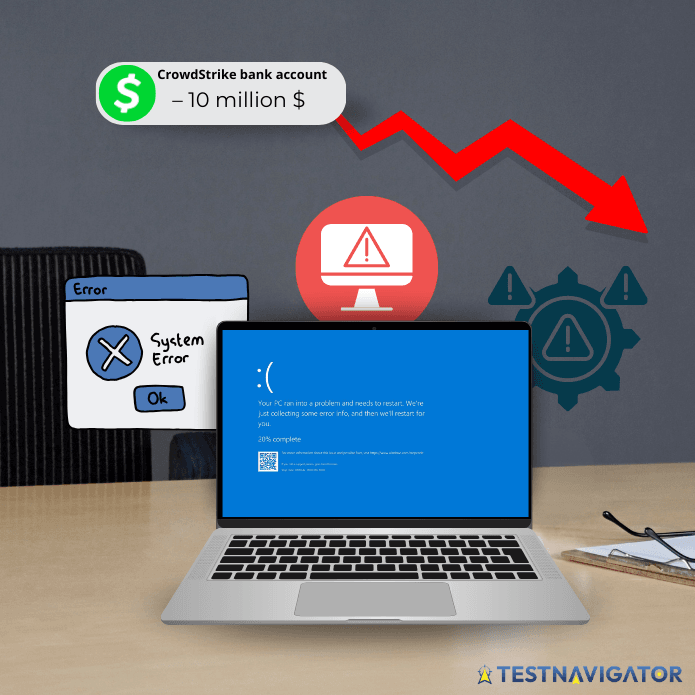
In July 2024, one of the world's largest IT outages crippled companies globally. CrowdStrike, an American cybersecurity company that protects thousands of organizations worldwide with its advanced endpoint security solutions, released a faulty update with severe consequences.
The problematic software update rendered more than 8.5 million computers unusable, with estimated damages exceeding 10 billion dollars. The incident not only shook the cybersecurity sector but also served as a reminder to every development and testing team of how expensive inadequate testing can be.
What exactly happened during the CrowdStrike incident?
CrowdStrike released a system update containing a bug in the kernel-level driver. This bug caused Windows systems to crash with a blue screen, paralyzing airlines, banks, hospitals, and government services worldwide. The root of the problem: The core issue was the absence of full-scale regression testing for the update, leaving many critical code segments unverified. The coverage of key components was neither properly measured nor validated, meaning the development team had no accurate data on how the changes would impact the broader system. Additionally, the release decision was made manually under time pressure rather than through objective, data-driven processes, increasing the risk of releasing faulty code.
The coverage gap: the hidden risk
Most bugs don’t live in new features but in modified or reused code segments. If these aren’t specifically tested, the risk grows exponentially.
A test coverage tracking and analysis tool like TestNavigator addresses this by:
- Measuring in real-time which code segments were executed during testing,
- Prioritizing test cases to ensure that the most important ones aren’t accidentally omitted from the test process,
- Identifying untested or under-tested parts,
- Assisting with setting Exit Criteria to make a well-informed decision on whether the software is ready for safe release.
Data-driven decision-making before release
The lesson from the CrowdStrike case is simple, yet many organizations overlook it:
"A release should never be based on gut feeling, but on data."
Modern test management tools allow you to define precise, measurable coverage levels and let the system automatically assign a "Go" or "No-Go" status based on current test data. These solutions not only help prevent the financial and reputational damages of faulty releases but also provide transparency in the testing process. Team members can see test progress in real time, understand which areas need attention, and thus foster better coordination and collaboration between development and testing.
What can we learn from this incident?
- A software release is not only a technical decision but also a business one.
- A lack of test coverage data = unknown risk.
- Real-time testing data facilitates fast yet safe releases.
- A good testing strategy not only finds bugs but reduces risk.
The new norm for safe releases
The CrowdStrike incident was an expensive but enlightening lesson for the software development and testing industry: software quality isn’t optional—it’s a form of business risk management. Tools like TestNavigator help development and QA teams understand exactly what was tested, what wasn’t, and when it is safe to release a new version.
The 10 billion dollar mistake could have been avoided if testing had been a data-driven decision rather than a secondary task to cross off the checklist.